
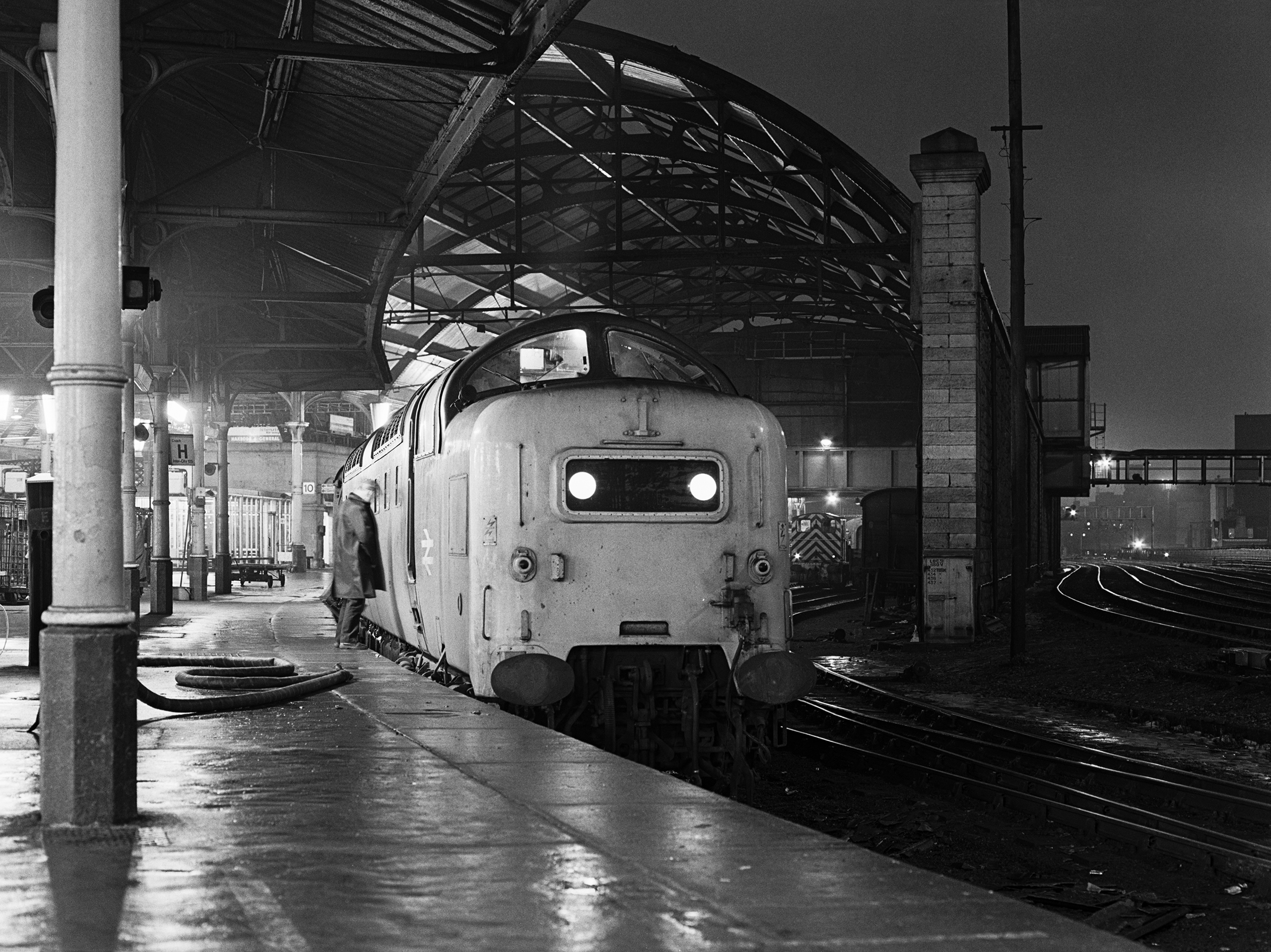
In December 2025, a 65-year-old Napier Deltic power unit roared back to life at Barrow Hill Depot after 44 years of silence — longer than the entire operational career of the Class 55 Deltic fleet. Power unit 430, last run in service aboard 55008 ‘The Green Howards’ in December 1981, was restored by Deltic Preservation Society volunteers at a cost of £45,000 and installed in 55009 ‘Alycidon’, returning the locomotive to full 3,300-horsepower operational status.
How Did PU430 Survive 44 Years in Storage?
In the early hours of 30th December 1981, Class 55 Deltic 55008 ‘The Green Howards’ stood at Newcastle Central station with the Up ‘Night Aberdonian‘, its twin Napier engines thrumming for what would prove to be the locomotive’s final revenue-earning service. Within 24 hours, flat batteries and brake-block issues at Finsbury Park MPD would end its working life. Three days later, the entire Deltic fleet followed into retirement, swept aside by the High Speed Trains just as they had themselves displaced the Gresley Pacifics two decades earlier.
What happened next to 55008 followed the familiar, melancholy pattern of most withdrawn Deltics: the journey to Doncaster Works, followed by cutting torches and the scrapyard. Yet parts of this magnificent machine survived. The number 2 end cab was purchased privately, eventually restored, and now sits in the Deltic Preservation Society’s depot at Barrow Hill, where visitors can step inside and imagine the roar of those Napier engines. And just a few feet away from that preserved cab, another survivor rested: power unit 430.
This particular Napier engine had accumulated only 2,633 hours since its last overhaul when it was removed from 55004 and installed in 55008 in November 1981 — mere weeks before the end of Deltic operations. For the next 44 years, PU430 remained silent, a sleeping giant surrounded by the bustle of the DPS depot at Barrow Hill.
Why Did 55009 ‘Alycidon’ Need a New Power Unit?
Fast forward to May 2024, and fate intervened once more. The DPS’s flagship locomotive, 55009 ‘Alycidon’ — one of only three main-line certificated Deltics in preservation — suffered a power unit failure. PU451 entered a period of inactivity, leaving Alycidon limping along on a single engine, much diminished from its 100mph glory days on the East Coast Main Line.
The solution lay sleeping nearby. PU430, with its remarkably low hours and relatively recent last service, became the focus of an ambitious restoration project. The DPS volunteers and supporters dubbed it “the triangle” — three locomotives whose fates had become inextricably linked. PU430 had originally been earmarked for D9015 ‘Tulyar’, but when PU417 in that locomotive appeared not to have been de-phased, 430’s destiny changed course toward 55009 ‘Alycidon’.
What Did the £45,000 Restoration Involve?
The restoration of a Napier Deltic engine after more than four decades of inactivity is no small undertaking. These are not simple diesel engines; they are complex, precision-engineered marvels that powered Britain’s fastest express trains. Each Deltic locomotive contains two of these mighty 18-cylinder opposed-piston engines, each capable of producing 1,650 horsepower.
The overhaul of PU430 involved several critical technical stages:
- Phasing case overhaul: The phasing case — a complex component housing enormous gear wheels that synchronise the three crankshafts within each Napier engine — received a “zero hours” overhaul by Compact Orbital Gears in Rhayader, South Wales. Remarkably, despite 40 years of storage, the phasing case was found to be in surprisingly good condition, a testament to both the quality of the original engineering and the care taken during storage.
- Fuel system refurbishment: All fuel pumps and injectors underwent complete refurbishment to original specification.
- Generator overhaul: Both the main and auxiliary generators received full strip-downs, part renewals, and rigorous testing by contractor Dorlec, at a cost of roughly £14,000.
- Governor rebuild: The engine governor, crucial for precise speed control, was fully refurbished to original specification.
- Plumbing and seals: All internal coolant and oil hoses required replacement. Initial pressure tests revealed multiple leaks from the injector and blanking plug pockets, necessitating a complete teardown of the pockets to fit new O-rings. Only when the unit proved leak-free could the project proceed to the next stage.
PU430 Key Specifications
| Detail | Value |
|---|---|
| Engine type | Napier Deltic 18-cylinder opposed-piston |
| Power output | 1,650 horsepower (per engine) |
| Weight | 11 tons 6 hundredweight |
| Hours since last overhaul (at withdrawal) | 2,633 |
| Last locomotive in service | 55008 ‘The Green Howards’ |
| Years in storage | 44 (1981–2025) |
| Restoration cost | Approximately £45,000 |
| Restoration contractors | Compact Orbital Gears, Dorlec, Merritts Machinery Logistics |
How Was the Power Unit Installed in 55009?
In November 2025, the moment arrived. Assisted by Merritts Machinery Logistics using specialised lifting equipment, the DPS volunteers prepared for the power unit swap at Barrow Hill Depot. The roof section of 55009 was carefully removed, the failed PU451 extracted, and PU430 — all 11 tons and 6 hundredweight of precision-engineered British muscle — was lowered into position. The extracted PU451 was returned to the depot to occupy the space previously filled by 430, awaiting its own future restoration.
When Did PU430 First Run After 44 Years?
On Wednesday, 10th December 2025, hearts were in mouths and fingers were crossed. After 44 years of silence — longer than the entire operational life of the Deltic class — PU430 was started. The distinctive bark of a Napier Deltic engine echoed around Barrow Hill once more as the sleeping giant roared back to life.
For those who remember the Deltics in service, that sound is unforgettable. The characteristic howl of the Napier engines, the smell of diesel exhaust, the vibration through the platform as these magnificent machines accelerated away with the “Flying Scotsman” or “The Talisman” — these are the sensory memories that define an era of British railway history.
What Does This Mean for 55009 ‘Alycidon’?
Following successful test runs on the Barrow Hill branch line in January 2026, PU430’s installation returned 55009 ‘Alycidon’ to full two-engine operational status. Once again, this thoroughbred of the East Coast Main Line stands ready to haul enthusiast specials and heritage railway trains, its twin Napier engines providing the 3,300 horsepower that once propelled express trains at speeds up to 100mph.
The success of this restoration has inspired the DPS to apply the same model to another “low hours” unit, PU423. A GoFundMe appeal has been launched to fund its estimated £45,000 overhaul, ensuring that the knowledge, skills, and techniques developed during the PU430 project can be put to use once more.
PU430 Restoration Timeline
| Date | Milestone |
|---|---|
| November 1981 | PU430 installed in 55008 ‘The Green Howards’ |
| 30 December 1981 | 55008 works final revenue service (Up ‘Night Aberdonian’) |
| January 1982 | 55008 withdrawn; PU430 enters storage at Barrow Hill |
| May 2024 | 55009 ‘Alycidon’ suffers PU451 failure |
| 2024–2025 | PU430 overhaul: phasing case, generators, fuel system, seals |
| November 2025 | PU430 lifted into 55009 at Barrow Hill Depot |
| 10 December 2025 | PU430 started for the first time in 44 years |
| January 2026 | Successful test runs; 55009 returns to full operational status |
A Testament to Dedication
The story of PU430 is more than just a mechanical restoration. It represents the extraordinary dedication of the Deltic Preservation Society’s volunteers, supporters, and contractors who refused to let these iconic locomotives fade into history. It demonstrates that with sufficient skill, determination, and financial support, even a 65-year-old engine silent for 44 years can be brought back to full operational life.
As PU430 settles into its new home within 55009, powering the locomotive that shares its preservation story, one cannot help but reflect on the interconnected fates of these machines. The cab of 55008, where PU430 last ran in service, sits nearby at Barrow Hill. The power unit it replaced, PU451, awaits its own restoration. And 55009 ‘Alycidon’, purchased by the DPS in 1982 following withdrawal, continues to carry the torch for an entire class of locomotives that once represented the pinnacle of British diesel traction.
The Deltics may have been replaced by High Speed Trains in the 1980s, but thanks to the work of societies like the DPS, their distinctive bark can still be heard on Britain’s heritage railways — and occasionally on the main line itself. The awakening of PU430 ensures that this magnificent chapter of British railway history will continue to thunder into the future.
Frequently Asked Questions
What is a Napier Deltic engine?
The Napier Deltic is an 18-cylinder opposed-piston diesel engine arranged in a distinctive triangular (delta) configuration with three crankshafts. Originally developed for Royal Navy fast patrol boats, it was adapted by English Electric for railway use. Each engine produces 1,650 horsepower, and every Class 55 Deltic locomotive carried two, giving a combined output of 3,300 horsepower — making them the most powerful single-unit diesel locomotives on British Railways when introduced in 1961.
How many Deltic locomotives survive in preservation?
Six of the original 22 Class 55 Deltics survive in preservation. Three hold main-line certification, allowing them to operate on the national rail network: 55009 ‘Alycidon’ (Deltic Preservation Society), 55002 ‘The King’s Own Yorkshire Light Infantry’, and 55019 ‘Royal Highland Fusilier’. The remaining three are based at heritage railways and preservation sites.
What is the Deltic Preservation Society?
The Deltic Preservation Society (DPS) is a volunteer-run organisation dedicated to preserving and operating Class 55 Deltic locomotives. Based at Barrow Hill Roundhouse near Chesterfield, the DPS maintains 55009 ‘Alycidon’ and D9015 ‘Tulyar’, along with a collection of spare power units, components, and historical artefacts. Memories of Motion supports the DPS through its DPS Collection of premium Deltic prints, with 100% of profits going directly to the society’s preservation work.
How much does it cost to restore a Napier Deltic power unit?
The overhaul of PU430 cost approximately £45,000, covering the phasing case rebuild, fuel pump and injector refurbishment, generator overhauls (£14,000 alone), governor rebuild, and extensive plumbing and seal replacement. The DPS has launched a GoFundMe appeal to fund the next power unit restoration (PU423) at a similar cost.
Can I see and hear a Deltic locomotive in action?
Yes. The DPS regularly operates 55009 ‘Alycidon’ on heritage railways and occasionally on the main line for enthusiast specials. Barrow Hill Roundhouse also hosts open days where visitors can see the DPS’s collection of Deltic locomotives, power units, and memorabilia. Check the DPS website at www.thedps.co.uk for upcoming events and running dates.
The Deltic Preservation Society welcomes new members and supporters. To learn more about their work preserving these iconic locomotives, visit www.thedps.co.uk
Memories of Motion is proud to support the DPS through our Ballymoss Collection of premium Deltic prints, with 100% of profits donated to the society’s preservation efforts.

Leave a Reply