A new photograph from Trevor Ermel
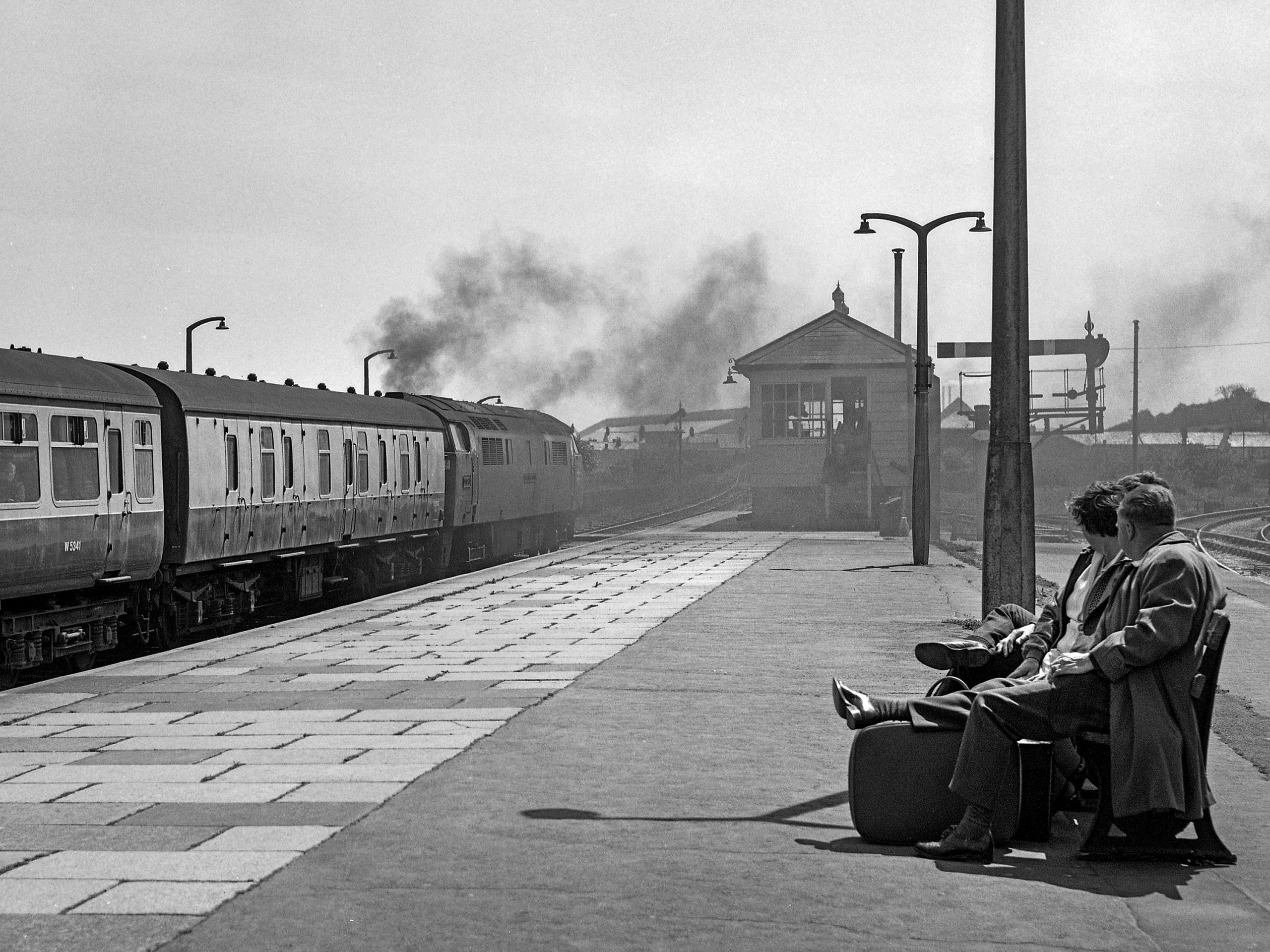
Class 52 Western D1047 ‘Western Lord’ pulls away from Par station in a heavy plume of exhaust, working the 1B25, the 09.30 from London Paddington to Penzance, on 30th May 1974: a diesel-hydraulic express caught at the moment of departure, smoke rolling back across the platform behind it.
It is the sort of afternoon that asks nothing of anyone. The passengers waiting on the platform are relaxed in the sunshine, taking in the smoke and, no doubt, the sound as the locomotive pulls away, the kind of low-level attention a departing train earns on any ordinary day. Not everyone shares that ease. The signalman and his visitor, close enough to catch the full benefit of the clag drifting past, seem rather less taken with it. A plume of diesel exhaust is atmosphere from a bench in the sun; it is something else again from a signalbox window.
Par sits on the Cornish main line, the junction where the branch to Newquay leaves the route running on down to Penzance, and by the summer of 1974 it was still seeing the locomotives that had made the Western Region’s approach to modernisation different from the rest of British Rail. The Class 52s were diesel-hydraulics, a form of transmission the Western Region adopted on its own account while the rest of the network standardised on diesel-electric power, and they carried the long-distance expresses to Cornwall under names that ran the length of the class: Western Lord among them, doing on this Thursday exactly the job she was built for, taking the London train on through Par towards Penzance.
That ordinariness is most of what makes the photograph worth keeping now. British Rail had already settled on diesel-electric traction as the national standard, and a class built specifically for one region, to work routes built specifically for that region, was never going to outlast locomotives built to a specification the rest of the network shared. The Westerns were withdrawn from service by 1977, the last main-line diesel-hydraulics to run in Britain and, as things turned out, the last there would ever be. There was a train to catch, sunshine to sit in, and a locomotive doing what locomotives at Par did every day the timetable required it.
Why this photograph?
What the photograph holds onto is that gap: an unremarkable departure, a plume of smoke that irritated a signalman more than it troubled anyone else, set against a class of locomotive and a form of traction that belonged to nowhere else on the network and would shortly belong to nowhere at all. The clag that drifts across this platform is the same clag that now marks the picture out precisely, a moment from a kind of railway Britain built once, ran hard while it lasted, and did not repeat.
Available as Prints and Frames
| Format | Sizes | Finishes | From |
|---|---|---|---|
| 12 x 9″, 16 x 12″, 24 x 18″ | Lustre, Gloss, Velvet, Photo Rag | £15 | |
| Matted Print | 14 x 11″ mount (12 x 9″ image), 20 x 16″ mount (16 x 12″ image) | Lustre, Gloss, Fine Art Pearl, Photo Rag | £32 |
| Sanctuary Framed Print | 14 x 11″ frame (12 x 9″ image), 20 x 16″ frame (16 x 12″ image) | Lustre, Gloss, Fine Art Pearl, Photo Rag | £109 |
| Fine Art Tray Frame | 16 x 12″, 24 x 18″ | Fine Art Pearl | £150 |
| Limited Edition Fine Art Float Frame | 20 x 16″ frame (16 x 12″ image) | Fine Art Cotton Smooth | £200 |
Browse the Western Clag at Par print and framed editions, or see more of our Trevor Ermel photography.
The photograph
- Locomotive: Class 52 Western D1047 ‘Western Lord’
- Location: Par
- Date: 30th May 1974
- Working: 1B25, the 09.30 London Paddington to Penzance
- Also in frame: waiting passengers; the signalman and his visitor
- Photographer: Trevor Ermel
Copyright Notice
This photograph is the copyright of Trevor Ermel. It is reproduced here by permission and offered as fine art prints and framed editions by Memories of Motion.
The image may not be copied, reproduced, redistributed, transmitted or used in any form, in print or digitally, without the prior written consent of the copyright holder. All rights reserved.
