
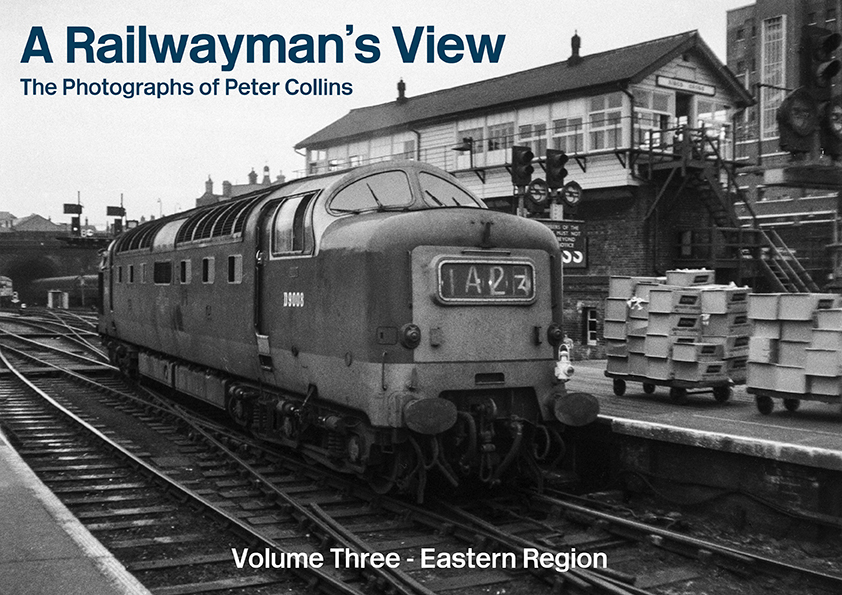
Peter Collins latest book
Volume Three – Eastern Region
Step into a world before the glorious London stations of Kings Cross and Liverpool Street were lost to the developers, and where the diesel engine ruled. Covering primarily the southern end of the East Coast Main Line (ECML) and the Great Eastern lines from London Liverpool Street. The route from Sheffield Victoria to Manchester Piccadilly showcases reflections on the Class 76 electrics, we catch glimpses of Lincolnshire and Yorkshire before a brief journey to the North East and Scotland. Scenes from Kings Cross and, particularly, Liverpool Street are almost unrecognisable today, their character and architecture lost to high-rise glass-fronted offices. Of all Peter’s photographs, those from the Eastern Region are perhaps the most poignant for ex-railwaymen, train spotters, and historians.
Kings Cross station is featured in three decades of photographs, from the 1960s to the 1980s. During the 1960s and 1970s, Kings Cross remained largely unchanged, reflecting its past as a steam station. However, after the opening of the new Moorgate tunnels and the electrification of the GN Suburban routes in the mid-1970s, the station began to lose its character, particularly from the platform level. The demise of the Deltics due to the advent of high-speed trains and the introduction of Class 91 InterCity 225 trains led to the closure of the station fuelling-point and Finsbury Park shed to the north. Looking from the platforms today, it’s hard to imagine the sheer volume of trains and locomotives that used to move around the station at the exits of the Gasworks Tunnels.
Highlights include:
- Almost the entire Class 31 “Toffee-Apple” fleet captured at Stratford shed
- Alan Pegler owned A3 4472 ‘Flying Scotsman’ blasting into Finsbury Park station
- Deltics at home Kings Cross.
- Pre-electrification suburban services at Kings Cross.
- Class 76s on the Woodhead Route
- The variety of traction in East Anglia
A notable theme in this book is the influence of Colin T Gifford, the celebrated railway photographer who pioneered a “New Approach” to railway photography. Gifford’s work, particularly during the decline of steam, often relied on abstraction to capture the “dirty working atmosphere” of the railways. He would photograph misty industrial landscapes, sweating railway workers, rain-swept nocturnal platforms, and sulphurous engine sheds, where trains might be an “afterthought” or entirely absent. Peter’s translation of Gifford’s philosophy is evident throughout the book, from the foggy March shed to the dark, moody photographs in the cavernous shed of Kings Cross station.
This third volume is a true walk down memory lane for many. It captures British Railways in all its glory and grime, and we can’t quite decide which one I like best. However, the photo of a young trainspotter wrapped up in his Parker coat with a Class 40 on a Parcels service at Huddersfield has to be the one that sparks the best memories for many train spotters!