
A new photograph from Ian Simpson
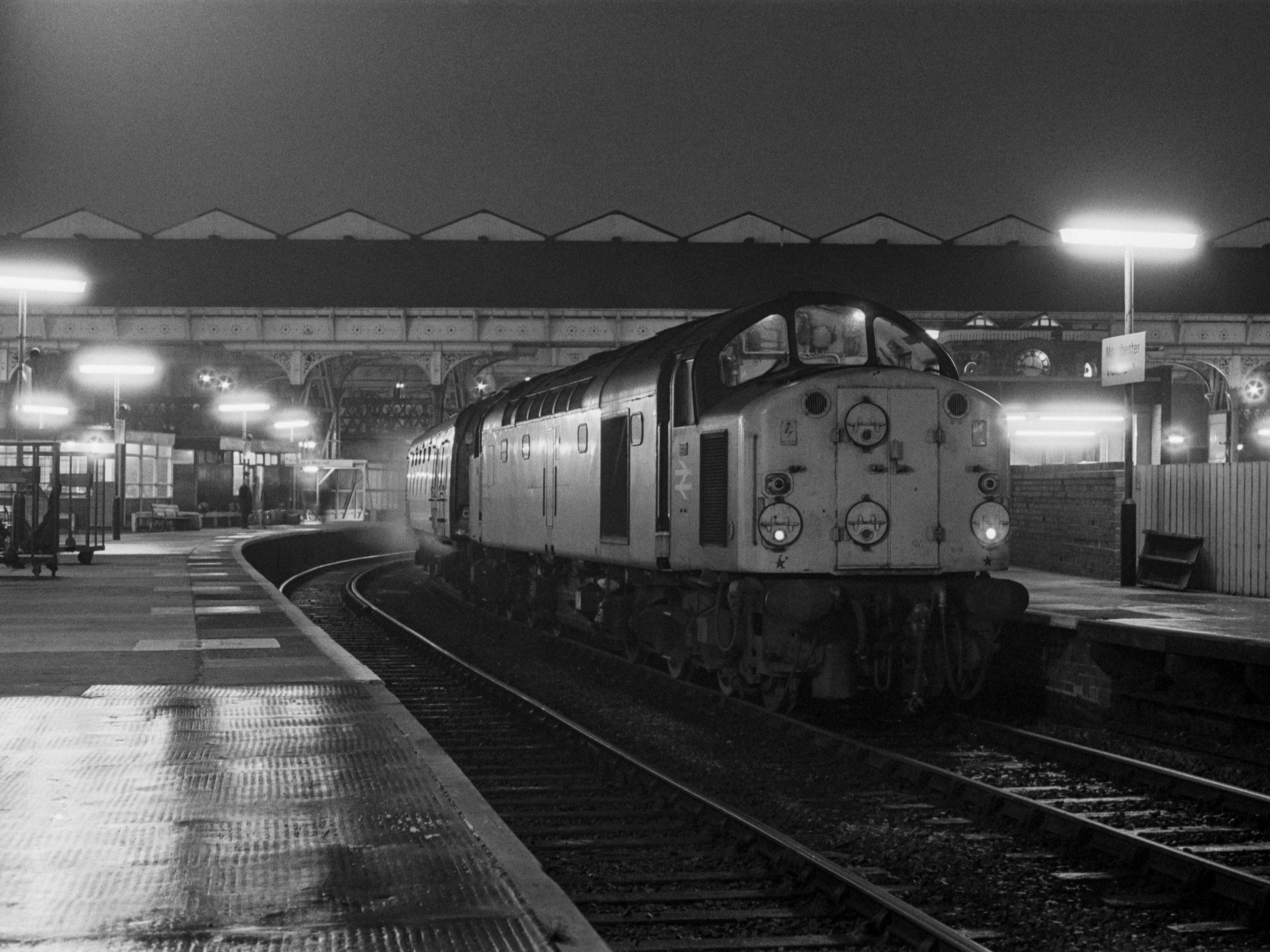
English Electric Class 40 40045 stands at Manchester Victoria on 23rd December 1975, at the head of the 21.15 service to Blackpool. It appears to be there because the diesel multiple unit diagrammed for the working has failed, and a locomotive with a rake of coaching stock has been found to cover it instead.
The platform around it is close to empty. A few BRUTE trolleys stand unattended, waiting, it seems, for the evening’s parcels trains rather than for this one, with nobody about to load or unload them. So close to Christmas, most of Manchester has better places to be than a windswept platform at Victoria this late in the evening: out celebrating, or at home getting ready for the day itself, rather than waiting on a delayed train to Blackpool. Steam drifts up from the carriages behind 40045, the heating working hard against a cold night, and it is that steam, more than anything else in the frame, that tells you exactly how cold it was. A trainshed built for crowds has, for once, almost none, and the effect of that emptiness is somehow colder than the weather alone would account for.
A diagrammed unit apparently failing on a service as ordinary as the 21.15 to Blackpool was nothing out of the way for British Rail in the mid-1970s. What is worth noticing is what was found to cover it. By this point in their working lives, the Class 40s, English Electric’s big Type 4s built at the end of the 1950s and into the early 1960s, had been pushed off the principal duties they were designed for by newer and more powerful classes, and locomotives like 40045 spent much of their time on secondary passenger turns, parcels work and freight, worked out of London Midland depots such as Longsight on Manchester’s edge. A failure on a short notice working like this one was exactly the kind of gap a Class 40 and a borrowed rake of coaching stock existed to fill. For anyone waiting to travel that night, a locomotive and a borrowed rake in place of the advertised unit meant a different journey from the one advertised: slower away from each stop than a multiple unit, and without the open, corridor free layout passengers might have expected.
Manchester Victoria at this date was not at its best, and nobody who used it then pretended otherwise. It was a magnificent station fallen on hard times, grimy and neglected in a way that mirrored British Rail’s own condition. It had once shared a very long platform with the neighbouring Manchester Exchange, long enough that finding out what was stabled at the western end meant a proper walk, and in its working life it carried a constant stream of freight and parcels traffic alongside local and long distance passenger trains. The West Coast Main Line workings that had once been the Class 40s’ natural territory had passed by then to newer, more powerful and, crucially, faster designs better suited to an increasingly electrified railway, and what had been an express class in its first decade had become, by 1975, a class living out its later years on exactly the kind of secondary and substitute work this photograph shows. Almost none of the Victoria in this photograph survives. The platforms and station buildings on this side of Victoria are now home to the Manchester AO Arena, and where main line trains once queued for platforms, concert-goers now queue for the arena, on evenings busy for entirely different reasons than a delayed train to Blackpool. 40045 itself didn’t last much longer either; it was withdrawn from service at nearby Longsight on 1st August 1976.
Why this photograph?
None of that is what holds you in this photograph, though. What holds you is a locomotive that was never meant to be working this train, standing in for a set that had broken down, on a platform with almost nobody left on it, in a station that was already becoming a memory of itself. It is a small, unremarkable disruption to an ordinary winter evening, kept only because somebody happened to have a camera to hand, and that is precisely what makes it worth keeping.
Available as Prints and Frames
| Format | Sizes | Finishes | From |
|---|---|---|---|
| 12 x 9″, 16 x 12″, 24 x 18″ | Lustre, Gloss, Velvet, Photo Rag | £15 | |
| Matted Print | 14 x 11″ mount (12 x 9″ image), 20 x 16″ mount (16 x 12″ image) | Lustre, Gloss, Fine Art Pearl, Photo Rag | £32 |
| Sanctuary Framed Print | 14 x 11″ frame (12 x 9″ image), 20 x 16″ frame (16 x 12″ image) | Lustre, Gloss, Fine Art Pearl, Photo Rag | £109 |
| Fine Art Tray Frame | 16 x 12″, 24 x 18″ | Fine Art Pearl | £150 |
| Limited Edition Fine Art Float Frame | 20 x 16″ frame (16 x 12″ image) | Fine Art Cotton Smooth | £200 |
Browse The Vic Whistler print and framed editions.
The photograph
- Locomotive: English Electric Class 40, 40045
- Location: Manchester Victoria
- Date: 23rd December 1975
- Working: 21.15 service to Blackpool, apparently a loco-hauled substitute for a failed DMU
- Also in frame: Empty BRUTE trolleys, awaiting the evening’s parcels trains
- Photographer: Ian Simpson
Copyright Notice
This photograph is the copyright of Ian Simpson. It is reproduced here by permission and offered as fine art prints and framed editions by Memories of Motion.
The image may not be copied, reproduced, redistributed, transmitted or used in any form, in print or digitally, without the prior written consent of the copyright holder. All rights reserved.
